Embroidering Resonant Circuits for Inductive Pressure Sensing
In this UIST paper, we present a novel method for embroidering fully soft resonant LC circuits to enable high-resolution inductive pressure sensing directly on textile substrates. Using a single continuous enameled wire, we integrate both the coil and the capacitor into the fabric through precise embroidery, forming a compact LC circuit without the need for external components. This resonant structure is combined with a ferromagnetic top layer and a soft, compressible foam, translating mechanical deformation into shifts in resonance frequency. The approach maintains the flexibility, softness, and washability of the base textile while adding robust sensing capabilities.
Our material exploration and fabrication study systematically evaluate embroidered geometries, conductive and ferromagnetic yarns, and foam types to optimize sensing performance. Among the tested materials, stainless-steel coated polyester yarn (Bart-Francis 3721) exhibited the strongest ferromagnetic response, resulting in the largest frequency shifts under pressure. Softer foams produced higher sensitivity, with values up to –1879 Hz/N, while stiffer foams reduced hysteresis and improved repeatability. Across 100 actuation cycles, the sensors showed high stability and minimal drift, demonstrating their suitability for long-term use. The resonant frequency peak around 2.7 MHz was clearly identifiable, confirming the robustness of the embroidered LC design.
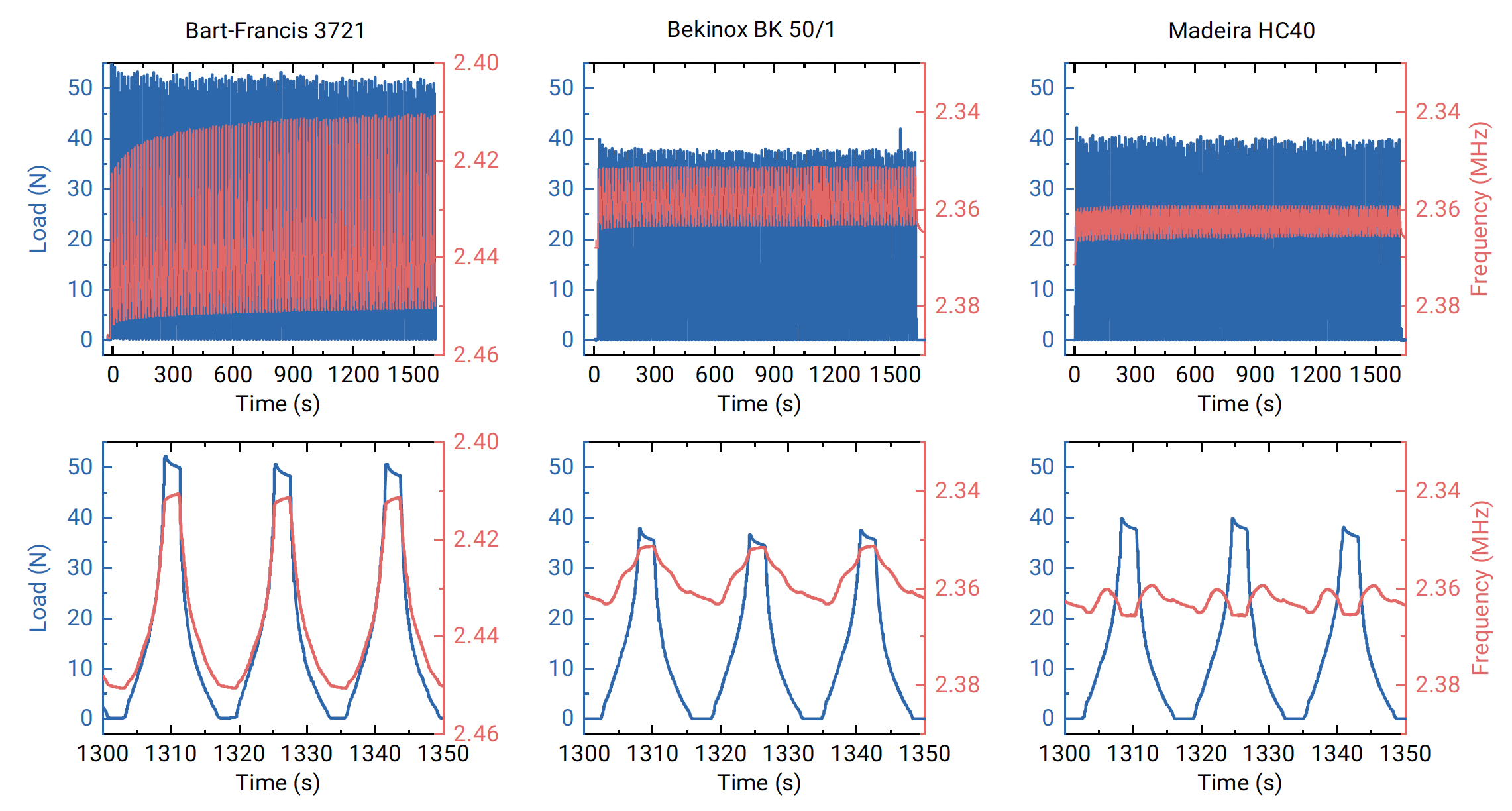
We illustrate the versatility of our sensing approach through three interactive applications: a smart pillow (A), which captures real-time deformation and maps it to a 3D digital twin in Unity; an interactive yoga mat (B), capable of detecting subtle weight shifts during standing or movement; and a chair that senses leaning direction (C), showing that the system can be embedded without adding bulk or altering the textile’s feel.

Overall, this work introduces a new sensing modality for e-textiles that combines high performance, durability, and seamless integration. By leveraging embroidery as both a structural and electrical fabrication method, our technique opens the door to next-generation wearable interfaces, smart furniture, and textile-based spatial interaction systems.
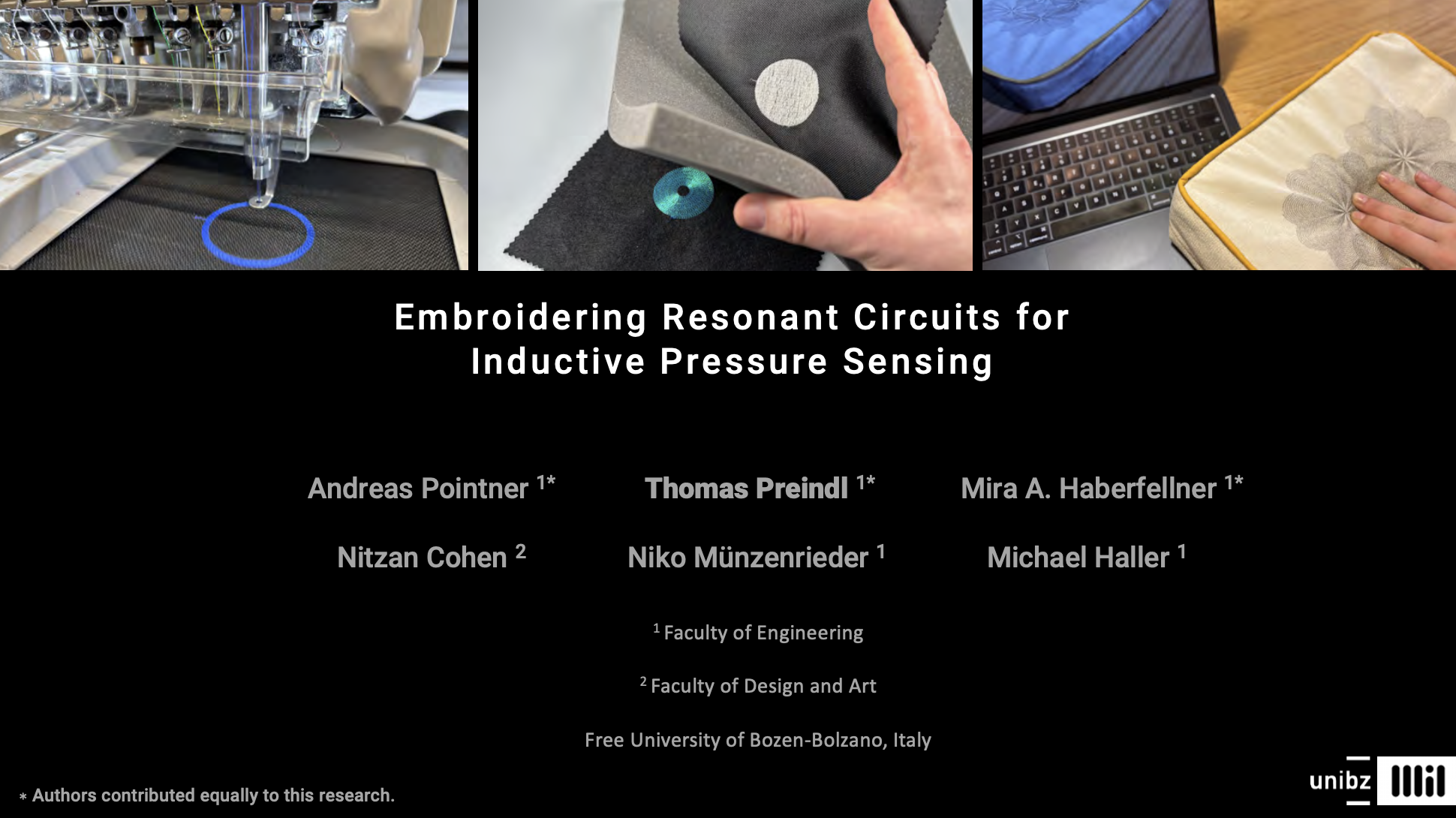
Presentation of UIST 2025, 28. Sept.- 1. Oct. 2025, Busan, Korea.
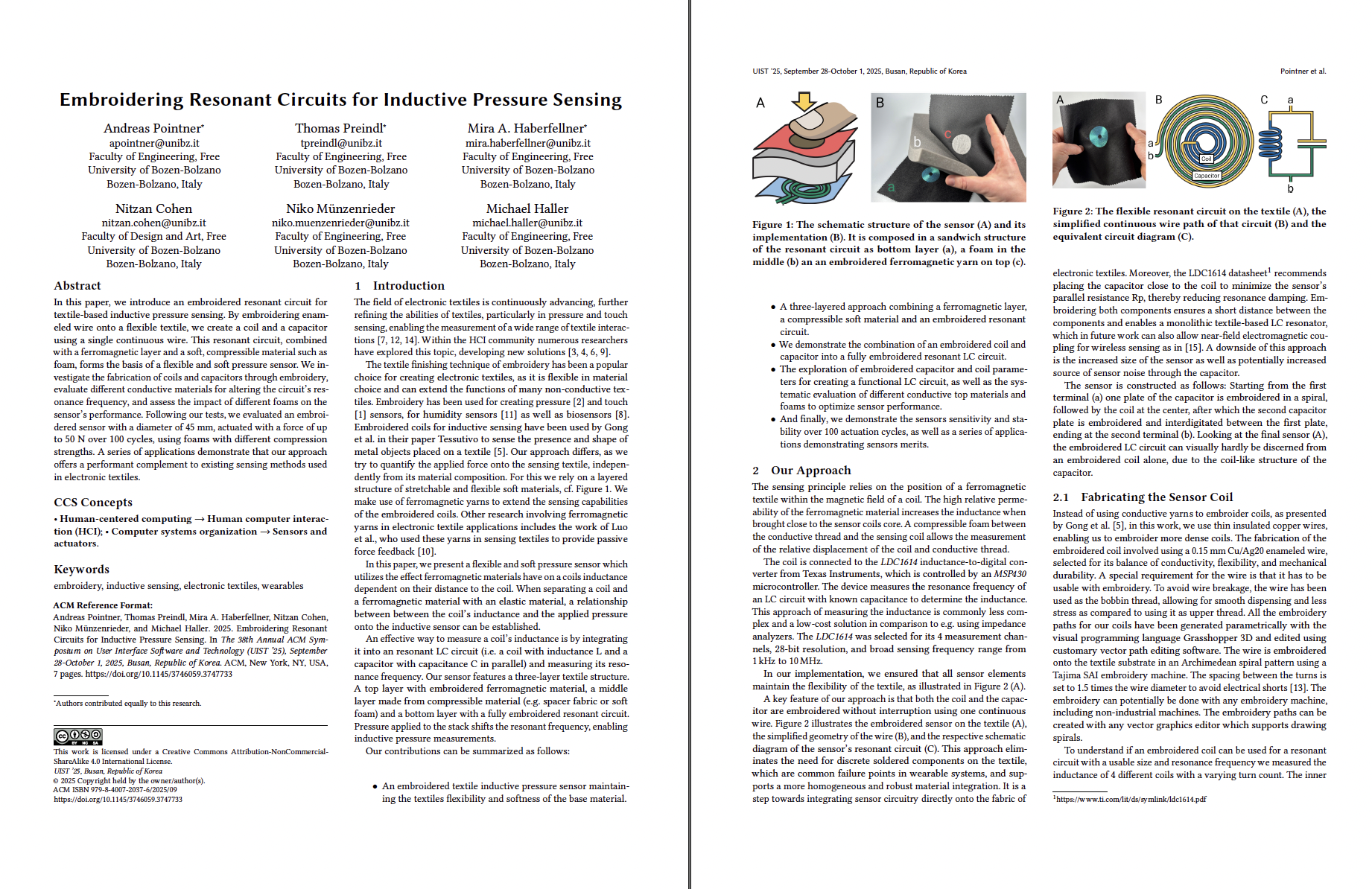
Pointner A, Preindl T, Haberfellner M, Cohen N, Münzenrieder N, and Haller M. 2025. Embroidering Resonant Circuits for Inductive Pressure Sensing. In Proceedings of the 38th Annual ACM Symposium on User Interface Software and Technology (UIST ’25). https://doi.org/10.1145/3746059.3747733