Knitted Inductive Flex Sensors for Wearable Applications
In this CHI publication we present a knitted inductive bend sensor which seamlessly integrates a coil and a capacitor into a soft and flexible tubular knit. By knitting enameled copper wires, we form a self-supporting coil, whose inductance changes with stretching and bending. Knitting both a coil and a parallel-wire capacitor, we create a textile resonant LC circuit, while preserving the softness, elasticity, and breathability of knitted textiles.
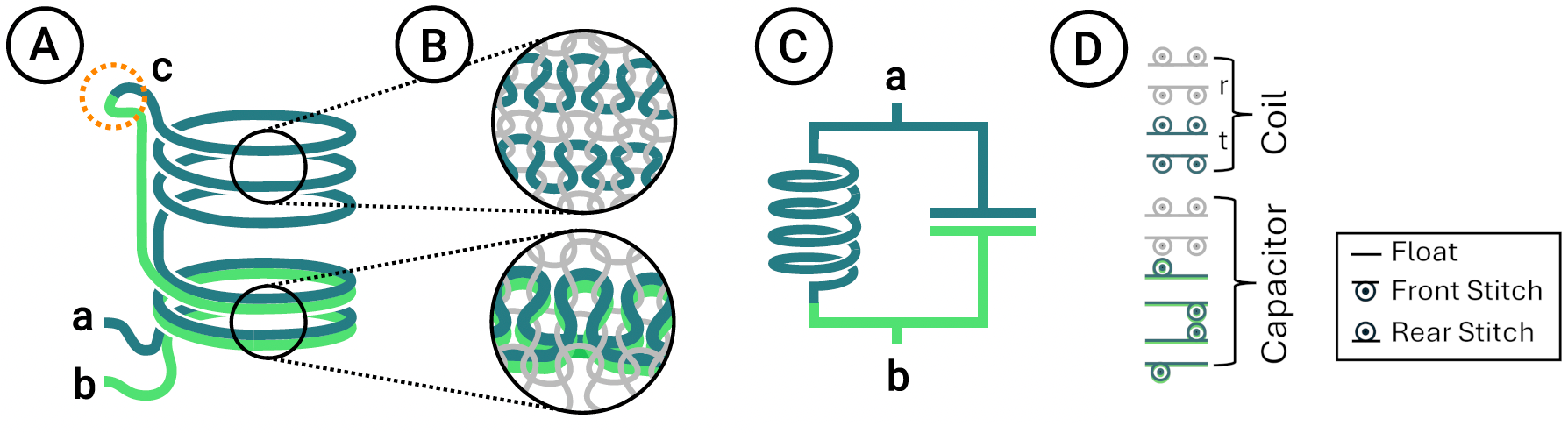
In a tubular knit, the yarn follows a helical path, which, when knitting thin enameled wires, allows for creating coils that are structurally self-supporting. This is in contrast to embroidered textile coils, which require a base textile and are usually flat. The sensing coils inductance changes the resonance frequency of an LC circuit. This frequency is measured and mapped to a bending angle of an enclosed joint, e.g. a knee or an elbow.
The integration of the capacitor of the LC circuit directly into the knit aims towards fully integrated electronic textile sensors, potentially allowing for wireless sensing of the resonance frequency through electromagnetic coupling. Omitting the need for a wire connection to the read-out electronics, which is often a breaking point for electronic textiles, can extend durability and washability.
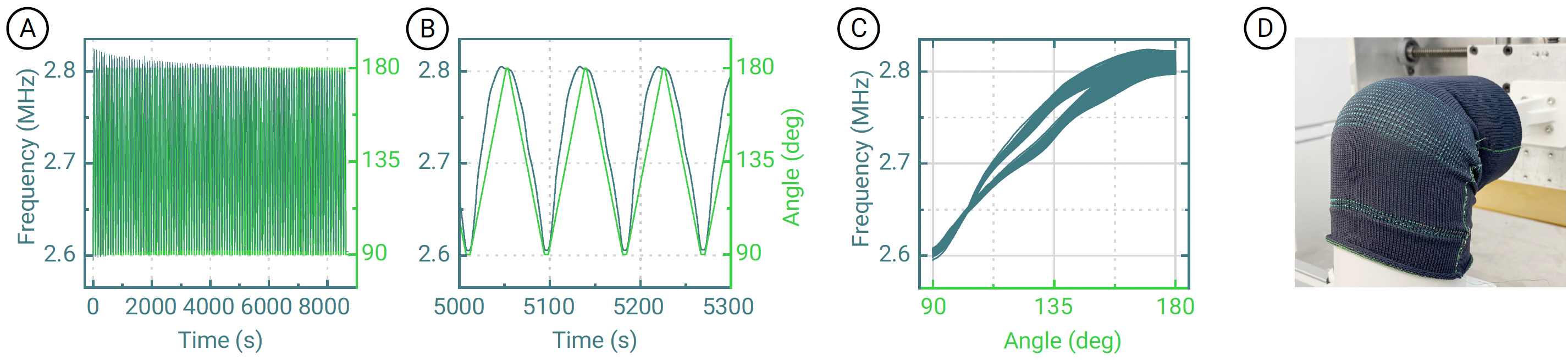
We fabricate the knitted sensors using our industrial V-bed knitting machine ADF 530 K, evaluate sensor sensitivity and hysteresis over 100 bending cycles, and demonstrate the sensors versatility across joints of different radii. Through our tests we could demonstrate a hysteresis of 16° and a sensitivity measured through the resonance frequency shift of -2.39 kHz/deg. Through mathematical modelling we could estimate the resonance frequency of a knitted circuit with 2.66 MHz comparing to the measured resonance frequency of 2.59 MHz. This allows us to design a sensor that fits the frequency range of our sensing hardware.
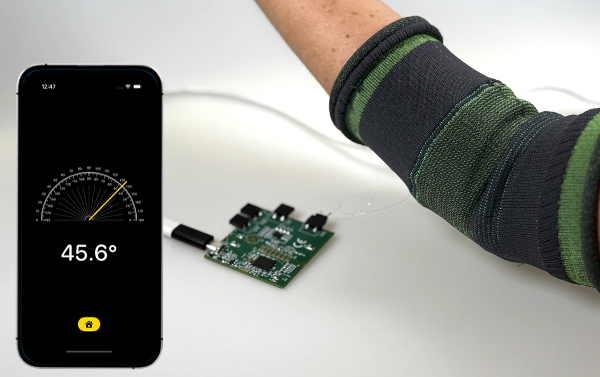
We implemented knee and elbow sleeve prototypes to illustrate how the knitted resonant sensors can be integrated into wearables that can sense body motion and a joints bending angle. Knitted inductive flex sensors are most suitable for applications where bending needs to be measured in only one direction, as the
deformation of the coil cannot be distinguished directionally.
The knitted LC circuit is a first step towards creating contactless sensing of fully knitted sensors. Our results show that knitted inductive sensors combine the wearability of soft textiles with the stability of inductive sensing, opening new sensing opportunities in healthcare, rehabilitation, and interactive electronic garments.
M. A. Haberfellner, T. Preindl, A. Pointner, N. Münzenrieder, and M. Haller. Knitted Inductive Flex Sensors for Wearable Applications. In Proceedings of the 2026 CHI Conference on Human Factors in Computing Systems Conference (CHI’26).
https://doi.org/10.1145/3772318.3791445