Designing Smart 3D-Printed Structures Leveraging Ferromagnetic Filaments for Inductive Deformation Sensing
In this CHI paper, we present InSense3D, a novel approach for designing smart 3D-printed structures that leverage inductive sensing to detect structural deformation without requiring internal wiring or electronics. By utilizing flexible lattices printed in TPU with ferromagnetic filaments, we create soft, deformable sensing structures that are completely passive. When the structure deforms under applied pressure, embedded ferromagnetic particles shift within the lattice, altering the magnetic field of a nearby coil. This results in a measurable change in inductance, enabling the system to detect and quantify structural deformation.
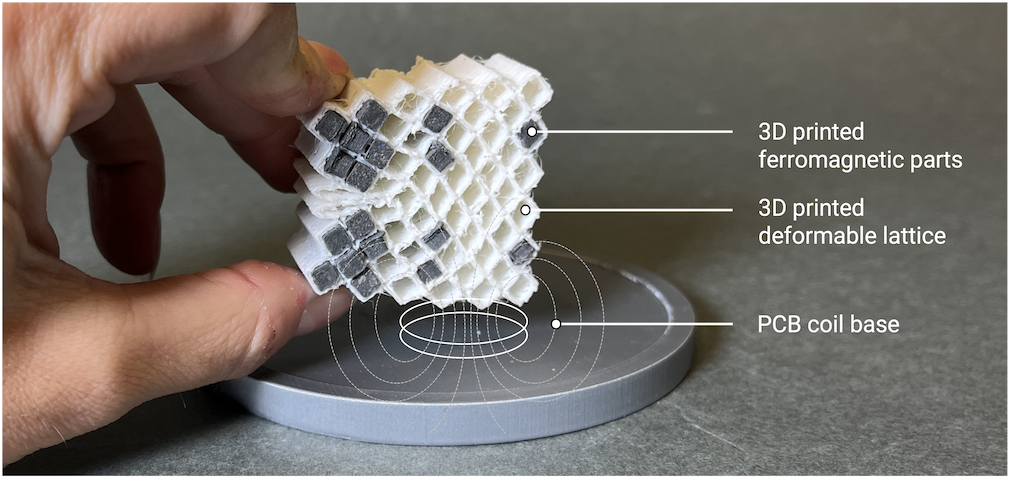
Apart from the sensing structures being completely passive, a key feature of the InSense3D approach is that users can easily swap different 3D-printed structures onto the same coil, instantly transforming them into tangible input devices tailored for different contexts. To design structures with different sensitivity characteristics, we systematically varied 4 key design parameters affecting the core configuration, namely distance, offset, size, and density; and also explored their combinations to study their effect on the sensor behavior.
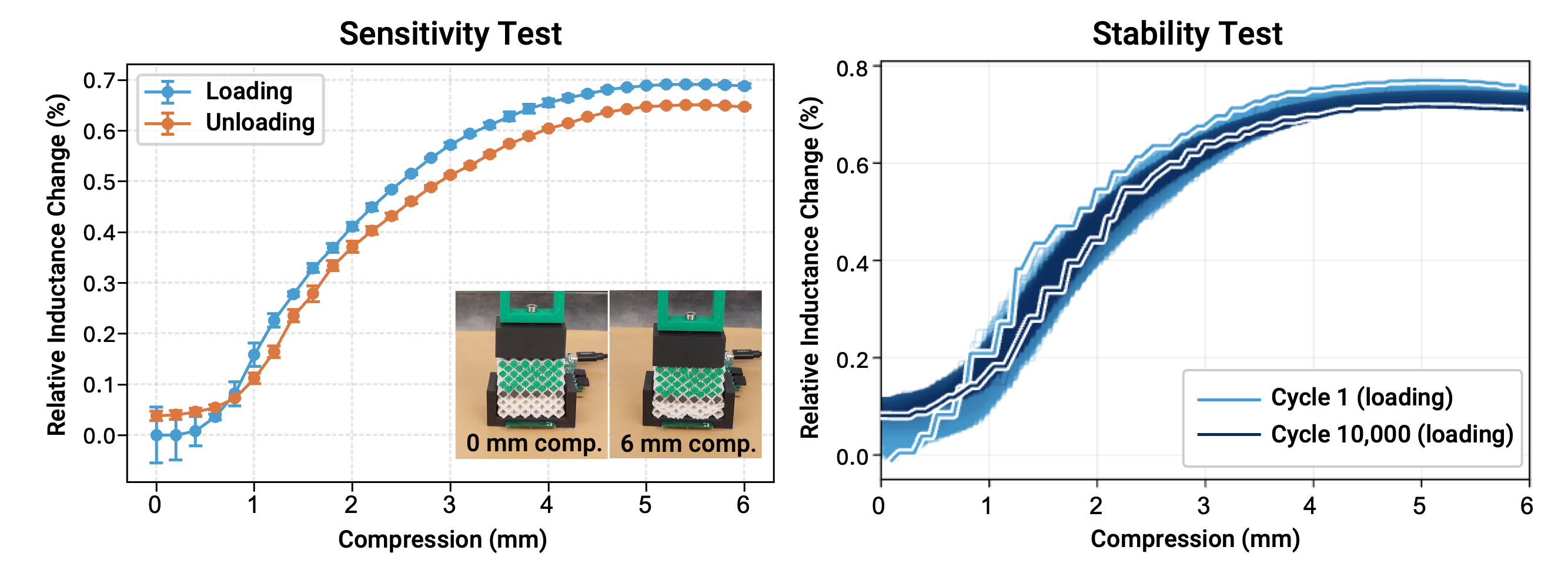
To evaluate the sensing performance of our approach, we assessed the sensitivity and long-term stability of one of our sensor samples. We observed that the sensor achieves a sensitivity of 0.23% relative inductance change per mm of deformation, as it is incrementally deformed in steps of 0.2 mm using an automated test setup. We also find that the sensor exhibits minimal drift, with the difference between the peak inductance values in the first and final cycles remaining within 0.05% of the initial inductance as the sample undergoes 10,000 compression cycles.
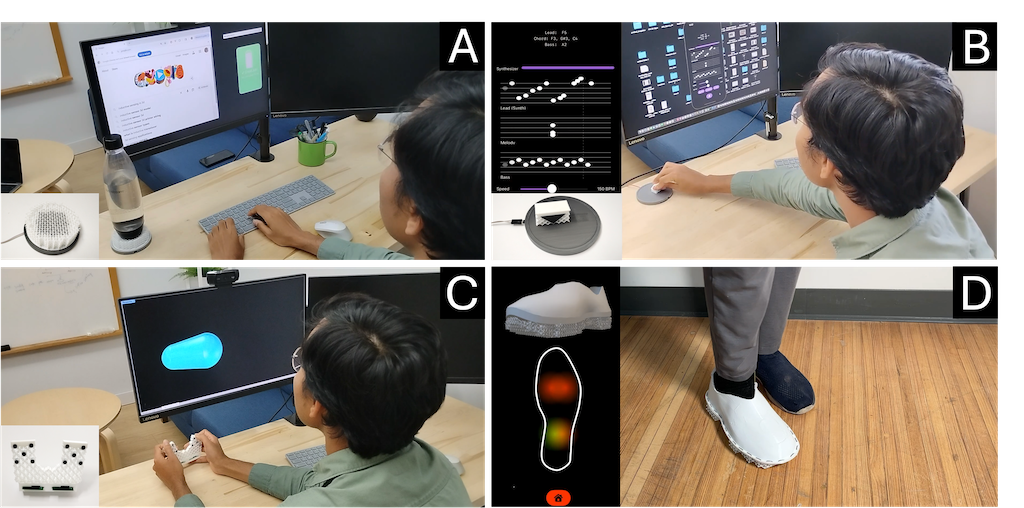
We demonstrate the versatility of our approach through four application categories: a smart bottle cover (A), which detects subtle changes in weight and deformation to estimate liquid intake in real time; a tabletop music controller (B), where tilting and pressing the structure produces different notes, enabling expressive interaction; a stretchable handheld controller (C), integrated with two coils and comprising a serpentine lattice structure that supports multi-dimensional interaction for applications such as gaming or sculpting; and a pressure-sensitive shoe sole (D), capable of mapping foot pressure during walking and generating a live heatmap of movement and posture.
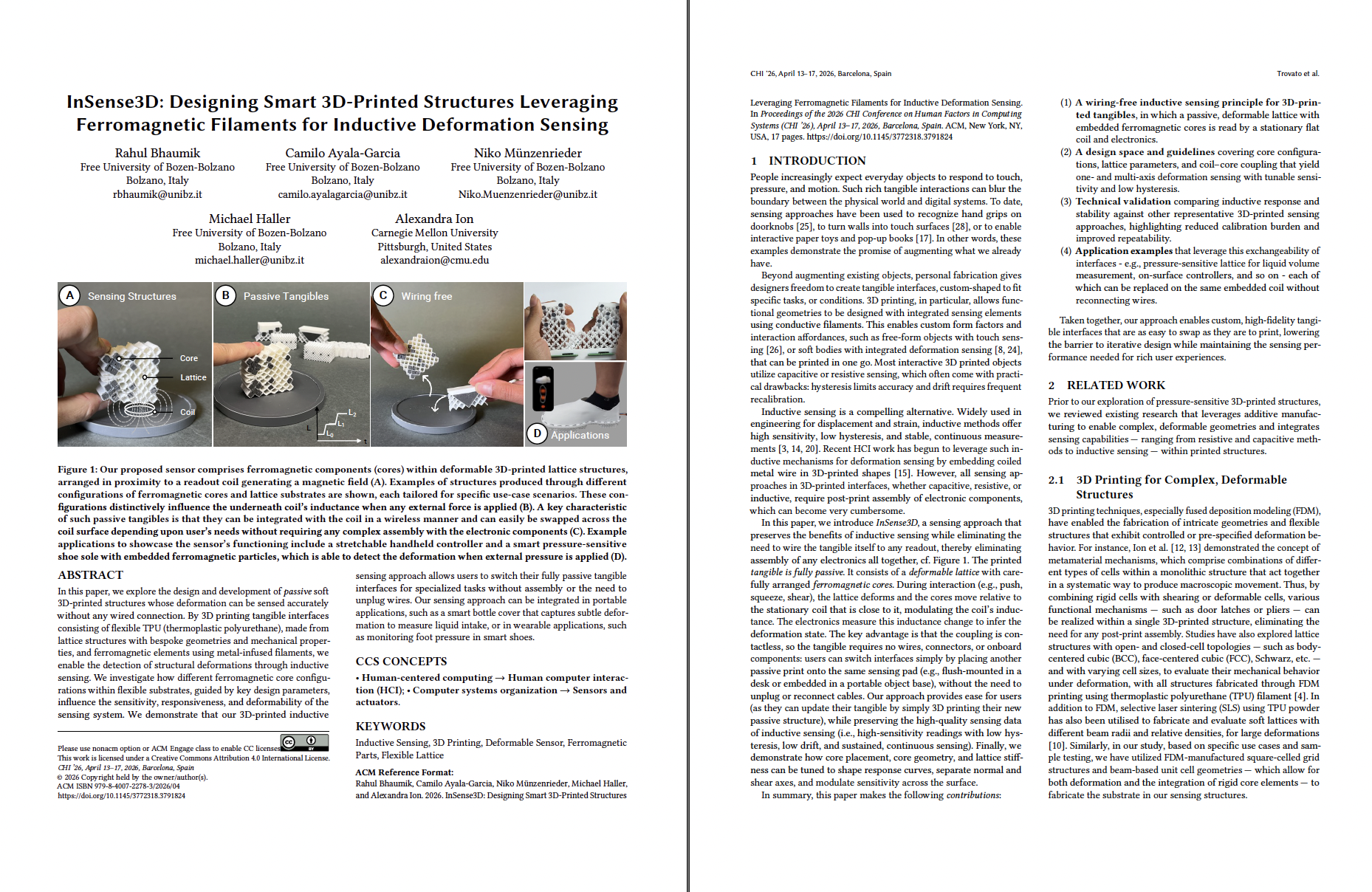
Bhaumik R., Garcia C., Münzenrieder N., Haller M., Ion A., InSense3D: Designing Smart 3D-Printed Structures Leveraging Ferromagnetic Filaments for Inductive Deformation Sensing, In Proceedings of the 2026 CHI Conference on Human Factors in Computing Systems Conference (CHI’26).